
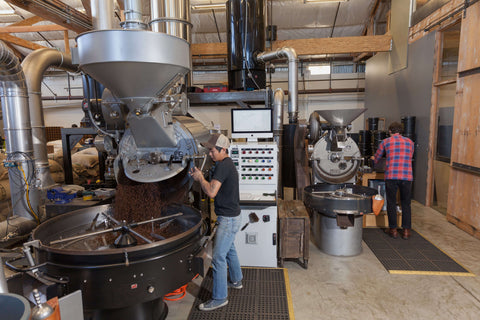
In specialty coffee, roasting a great batch is no longer enough. The real challenge is doing it again, consistently across people, places, and time. As roasteries grow, complexity increases. New coffees come into rotation, production scales up, and teams expand. What once relied on individual intuition now needs to translate into systems that support the flow of coffee through the business, from production and inventory to sales.
In collaboration with Cropster—a platform designed to support the coffee value chain from green bean to cup—we spoke with four roasteries operating across Asia and Europe: Alchemist, The Miners, Coffee County, and REC COFFEE.
Across different regions and business models, they are working toward the same question: how do you reproduce a great cup of coffee, not just once, but at scale?
From Recording to Operating
For many roasters, documentation began as a manual process—handwritten notes capturing temperatures, times, and observations. They are valuable, but difficult to standardize or scale.
Before adopting a unified system, all four roasteries faced similar challenges. Record-keeping varied from person to person, making it hard to establish shared standards. Logging data during production introduced human error, especially when attention was split between roasting and recording. As teams expanded, knowledge became harder to transfer, particularly when it relied on individual intuition.
As operations expanded, these limitations became more visible. What is changing is not how much data is collected, but how it is used. Recording is no longer just about documentation. It is about informing the next roast, the next purchase, and the next operational decision.
Connecting Numbers to Taste
As data accumulates, the role of the roaster begins to change, becoming less about instinct alone and more about reproducible decision-making.
At Alchemist, cupping results are linked directly with roast profiles, allowing the team to verify whether what they tasted at origin is accurately reproduced in production. At The Miners, structured logging revealed subtle temperature fluctuations during roasting that correlated with inconsistencies in the cup. Further analysis showed that variations in moisture content were affecting heat absorption—insights that would have been difficult to identify without structured data.
Across all cases, the objective is not simply to collect data. It is to move between numbers and taste, using one to better understand the other.
From Individual Skill to Team Consistency
As roasteries grow, quality can no longer depend on a single person.
At REC COFFEE, shared data creates a common language across the team, allowing decisions to be grounded in consistent, accessible information rather than individual interpretation. This becomes especially important in a multi-location environment, where roasting, QC, and purchasing must stay aligned across teams. At Coffee County, quality control extends beyond the roastery floor. Through cloud-based monitoring, roasting activity can be observed remotely, allowing the head roaster to provide feedback during production rather than after it. This shifts roasting from a location-bound process to a continuously connected system, enabling visibility across multiple batches and more immediate operational decisions.
As teams expand and roles diversify, one question becomes central: how can quality be maintained regardless of who is roasting? Increasingly, the answer lies in systems that standardize processes and connect teams.
From Production to Retail
For many of these roasteries, roasting is only one part of the operation.
As they expand into retail and wholesale, the challenge shifts from producing great coffee to managing how it moves through the business. Coffee must flow across locations and sales channels in a way that reflects what was intended at the production stage.
This connection between production data and retail operations is becoming increasingly important. Decisions about roasting are no longer made in isolation. They are shaped by real demand across cafés, partners, and customers.
Inventory as a Bridge
Inventory management sits at the center of this shift.
Across the four roasteries, inventory is no longer treated as static stock, but as an operational layer connecting roasting, purchasing, and retail decisions.
For production control, Alchemist links green inventory directly to roasting schedules, enabling a just-in-time approach that helps maintain freshness while reducing waste across multiple retail locations. At The Miners, lot-level traceability supports precise management of multiple batches from the same origin, improving both blending accuracy and quality control.
On the demand side, REC COFFEE uses consumption data to inform purchasing decisions and align production planning with real sales across cafés and online channels. At Coffee County, inventory is integrated into broader operational planning, linking roasting activity with purchasing cycles and long-term demand forecasting.
Across all cases, inventory is no longer just about stock levels. It becomes a system that connects production, purchasing, and retail operations.
What Becomes Clear
Across all four roasteries, one idea emerges consistently: data and intuition are not opposing forces, but complementary tools. As data becomes embedded in daily operations, it forms a shared foundation that allows quality to extend beyond any single individual or location. At the same time, rising green coffee prices and increasingly complex supply chains are making that foundation more critical than ever.
Roasting is no longer just about transforming green coffee. It now sits within a broader system that links sourcing, production, and how coffee ultimately reaches the customer.
In Their Own Words
Each roastery operates in a different context, but their experiences show how these systems function in practice. Rather than a single approach, what emerges are shared principles applied in different ways.
The following conversations offer a closer look at how these ideas take shape in daily operations.
The Miners
Founded in 2019 in Prague, The Miners is a specialty coffee roastery that has expanded across Europe, positioning itself as a cultural hub centered around coffee.

Q1: What was the biggest challenge before adopting a data system?
We relied on manual note-taking and subjective evaluation of roast profiles, which often led to inconsistencies. It was also difficult to track how environmental conditions and green coffee variations affected the final result.
Q2: What insight did data reveal?
By logging roast curves alongside green coffee data, we identified subtle temperature spikes during roasting that correlated with flavor inconsistencies. This led us to discover that variations in moisture content were affecting heat absorption, which allowed us to refine our profiles.
Q3: What feature do you rely on most?
The inventory management module plays a central role. It provides real-time visibility into stock levels, usage rates, and lot traceability, supporting both planning and quality control.
Q4: How does this impact your operation?
When working with multiple lots from the same origin, we can track and manage each batch individually. This improves blending precision and helps maintain consistency across seasonal espresso profiles.
Q5: What advice would you give to roasters looking to scale?
Prioritize building a culture of documentation and feedback. When decisions are supported by data and shared openly within the team, it becomes much easier to scale while maintaining quality.
Q6: What is the biggest challenge facing specialty roasters today?
Adapting to shifting supply chain dynamics is a major challenge. Green coffee availability is becoming less predictable, and costs are rising. Roasters need to balance innovation with sustainability while improving traceability and operational efficiency.
Q7: Looking back, what would you do differently?
We would invest in scalable digital systems from day one. Early adoption prevents operational bottlenecks and supports smoother growth as the business expands.
Alchemist
Founded in Singapore, Alchemist is a specialty coffee roastery built on the idea of making high-quality coffee more accessible, now operating across Singapore, Japan, and Taiwan.

Q1: What was the biggest challenge before adopting a data system?
Before using a centralized system, we relied heavily on handwritten logs while managing roasting at the same time. This made it difficult to accurately capture data during production, and human error was almost inevitable. Balancing operational tasks with proper documentation made consistency difficult to achieve.
Q2: What insight did data reveal?
One major shift came from connecting our sampling and cupping data directly with production roasts. This allowed us to check back on what we tasted at origin and verify whether we were actually reproducing those qualities in the final cup.
Q3: What feature do you rely on most?
Scheduling and green inventory forecasting have become essential. Having a clear overview of inventory in relation to our roasting plan allows us to anticipate when to restock or roast specific lots without relying on manual calculations.
Q4: How does this impact your operation?
We roast around 350kg per week across multiple product categories. With forecasting, we can manage just-in-time roasting, especially for filter coffee with a limited shelf life. This helps us minimize waste while ensuring freshness across multiple retail locations and aligning production with demand.
Q5: What advice would you give to roasters looking to scale?
Capture your data from day one. Having a centralized system that acts as a reference point for all your coffee data creates a strong foundation for growth and makes scaling much smoother.
Q6: What is the biggest challenge facing specialty roasters today?
Managing high-volume growth while maintaining strict quality standards across different markets is a key challenge. As operations expand, logistics become more complex, and maintaining consistency across wholesale and retail channels requires more structured systems.
Q7: Looking back, what would you do differently?
We would not hesitate to invest in better tools earlier. While cost was a consideration at the time, the value gained in forecasting, sampling, and operational efficiency has far outweighed the investment.
REC COFFEE
REC COFFEE is a Fukuoka-based specialty coffee roastery with multiple locations across Fukuoka and Tokyo.

Q1: What was the biggest challenge before adopting a data system?
We relied on handwritten records, which made it difficult to share understanding across a growing team. As the number of batches increased, reviewing past roasts became time-consuming, and aligning sensory perception with numerical data was challenging. Inventory management and forecasting also required significant effort.
Q2: What insight did data reveal?
Working with multiple roasting machines, we found that while roast curves differed, the key adjustment points for achieving a target flavor often shared common patterns. We also became more aware that excellent flavor does not always correspond to a “perfect” curve, deepening our understanding of the relationship between taste and data.
Q3: What feature do you rely on most?
Inventory management is one of the most important tools for us. It allows us to plan roasting and sales so that green coffee can be used at its best condition.
Q4: How does this impact your operation?
More accurate forecasting allows us to communicate expected volumes and quality targets to producers earlier. This improves purchasing decisions and strengthens relationships. It also enables better planning across retail and wholesale, reducing sudden stockouts and supporting more structured product communication.
Q5: What advice would you give to roasters looking to scale?
Keep detailed records. As operations grow, maintaining consistency becomes more difficult, and data becomes an essential tool that supports the entire team.
Q6: What is the biggest challenge facing specialty roasters today?
With costs continuing to rise, maintaining and improving quality is a major challenge. Reducing waste, building systems to support quality, and communicating the value and background of coffee to customers are all increasingly important.
Q7: Looking back, what would you do differently?
We would focus earlier on building systems designed for team-based production. Establishing a shared foundation from the beginning allows quality to be maintained as the organization grows.
Coffee County
Founded in 2013 in Kurume, Fukuoka, Coffee County is a specialty coffee roastery with locations in both Fukuoka and Tokyo.

Q1: What was the biggest challenge before adopting a data system?
Before Cropster, we used general-purpose logging software that allowed us to track temperature but not rate of rise (RoR). Since we consider RoR to be one of the most important variables in roasting, we needed a system that would allow us to properly monitor and analyze it.
Q2: What insight did data reveal?
We began measuring moisture content and density, which led us to better understand how these factors influence roast curves and RoR. We also recognized the importance of bean shape and size when designing roast profiles.
Q3: What feature do you rely on most?
Roast comparison. Being able to analyze past roasts in detail allows us to plan the next batch with much greater clarity.
Q4: How does this impact your operation?
Even when other team members are roasting, everything can be monitored remotely via the cloud, with immediate feedback provided as needed. This allows us to maintain quality control without being physically present, while also freeing up time for other responsibilities. Production reports also help us track overall output and green coffee consumption, improving purchasing decisions.
Q5: What advice would you give to roasters looking to scale?
Measure what can be measured and record everything. Sensory understanding alone is difficult to share, but when combined with data, it becomes easier to communicate and refine as a team.
Q6: What is the biggest challenge facing specialty roasters today?
Rising coffee prices are a major challenge and are likely to continue increasing. It is becoming more important to identify which coffees truly hold value, otherwise there is a risk of disconnect between producers and consumers.
Q7: Looking back, what would you do differently?
We would secure a larger space and invest in bigger equipment from the beginning. Initial capacity tends to be underestimated.
As roasteries expand beyond a single production space into multi-location businesses, the challenge shifts from making great coffee to managing how that coffee moves through the entire operation.
Platforms like Cropster are increasingly used to connect roasting, inventory, and retail—helping roasters scale while aligning production with real demand across wholesale and café networks. To explore how data can support both roasting and retail operations, visit Cropster’s website.